


Fishing at GG777: Smarter Shots, Targets and Game Choice
Fishing at GG777 turns the usual casino rhythm into an active shooting game: Choose a cannon level, spend on each shot, track fish values, and react to special targets. The useful part is not firing faster—it is knowing what each shot costs and when a target fits your budget.
Fishing at GG777
Fishing feels immediately different from slot games or live casino tables. Instead of waiting for reels or cards, you enter a moving underwater screen filled with fish, creatures, bosses and occasional special targets. Your cannon sits ready at the edge of the screen, and every shot becomes a decision.
Inside GG777, Fishing is built around this arcade-style rhythm. You choose where to aim, decide how aggressively to fire and adjust the value of your shots according to the game you have opened. The available selection can include titles such as King of Fish Shooting, V8 Fish Shooting, God of Wealth Fish Shooting, Mega Fishing and Royal Fishing.
That creates more involvement than simply pressing Spin, but it is important to read the action correctly. A large fish crossing the screen is not an invitation to empty the cannon into it. A high-value target may offer a larger reward, yet catching it is never guaranteed.
Aiming controls where you spend your shots. It does not turn a valuable target into a guaranteed catch.
Once that distinction is clear, Fishing becomes much easier to manage.
Shot Cost, Firepower and Fish Values
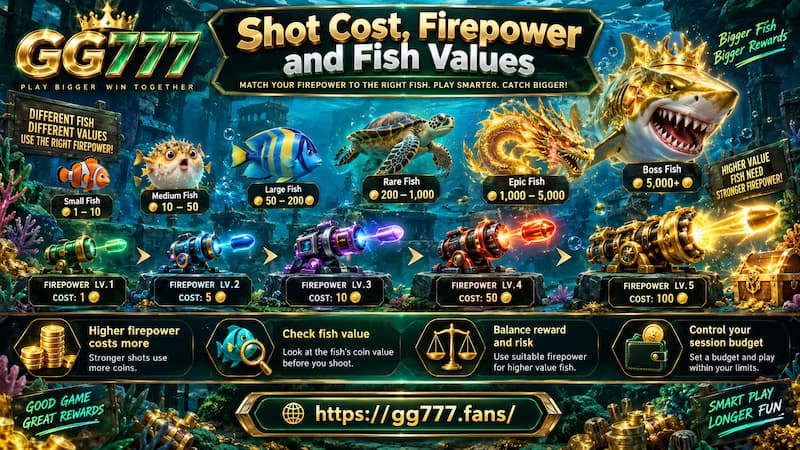
The cannon is the center of every Fishing session. Its firepower is not merely a visual upgrade. In games that tie bullet value to the selected betting level, raising the cannon also raises the amount committed whenever you fire.
Shot Cost, Firepower and Fish Values
One shot may look insignificant. Fifty quick shots are another story.
Consider a simple session with a ₱500 balance. If the selected shot costs ₱1, then 100 shots represent ₱100 of exposure. Move to ₱5 per shot and the same burst represents ₱500. The animation may last only a short time, but the financial difference is enormous.
That is why checking the cost per bullet before continuous firing is one of the most useful habits in Fishing.
Reading the Cannon Level
Before targeting anything, identify:
- The current bullet or cannon value.
- The minimum and maximum available firepower.
- Whether changing cannon level immediately changes shot cost.
- Whether special weapons use the same value as normal bullets.
- How quickly auto-fire or repeated tapping can consume the planned balance.
Higher firepower can make a cannon look and feel stronger, but it should not be treated as a progress level that always needs to move upward.
Sometimes the sensible setting is simply the one that lets the planned balance survive long enough to actually read the game.
Reading Fish Multipliers
Fish values give another piece of the picture.
In many fish-shooting games, an ordinary target is associated with a multiplier or reward value. If a game’s rules calculate rewards from the selected bet and target multiplier, the basic logic can be understood as:
Shot or bet value × target multiplier = potential reward
The important word is potential.
A 50x creature is not automatically a better shooting decision than a 5x fish. The larger number tells you about its reward value, not how many bullets you will spend attempting to catch it.
That difference becomes especially noticeable when several expensive targets arrive together. The screen gets exciting, cannons start firing everywhere, and it is easy to react to size instead of cost.
Special Fish, Bosses and Weapons
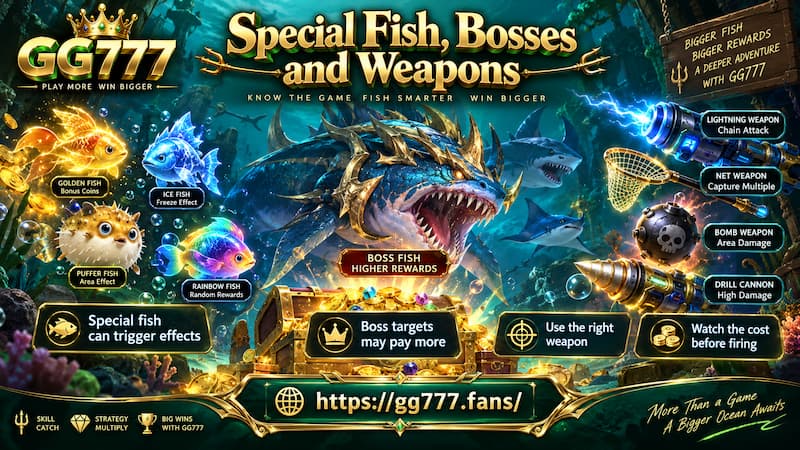
Ordinary fish teach the basic rhythm. Bosses and special creatures are where individual Fishing games begin to separate themselves.
Some introduce energy meters. Others bring bonus wheels, electrical attacks, special cannons, treasure mechanics or weapons that affect multiple targets. These features can completely change how a round feels, which is why two Fishing games should not be judged only by their graphics.
Special Fish, Bosses and Weapons
Mega Fishing
Mega Fishing is a useful example because the game mixes normal shooting with several special events. JILI lists the game with a maximum win of 950x and highlights the Special Octopus Wheel. Its official description also includes torpedoes, a railgun, Giant Anglerfish, Giant Crocodiles and the Mega Octopus.
That gives the screen several competing priorities.
You may be following a regular fish when a larger creature appears. A special mechanic can then change the pace again. Instead of reacting instantly, read how that feature works and whether it changes the normal reward calculation.
The biggest animation is not necessarily the signal to raise the cannon.
Royal Fishing
Royal Fishing takes a different route. Normal shooting also builds energy. Once the energy bar is full, a full-screen attack can be triggered. Boss encounters add another layer, while defeating the Money Dragon King can activate a multiplier wheel reaching up to 350x according to JILI’s official game information.
That produces a different decision flow from Mega Fishing.
You are not only watching individual fish. You also have an energy cycle to consider, plus bosses with their own features. Someone who enjoys building toward a larger event may prefer this rhythm, while another player may prefer a Fishing room where most attention stays on direct shooting.
Choosing a Fishing Game at GG777
A colorful lobby thumbnail tells you almost nothing about how a Fishing game will feel after five minutes.
Instead of choosing only by theme, compare the details that affect every shot.
Check the Rules Before the Graphics
Focus on these points:
- Bullet cost: Know the amount committed each time the cannon fires.
- Bet range: Check whether the lower settings fit the balance you intend to use.
- Target values: See how far ordinary fish differ from premium creatures and bosses.
- Special fish: Learn whether they pay directly or trigger separate mechanics.
- Boss features: Check for wheels, jackpots, energy attacks or other reward systems.
- Special weapons: Understand how they activate and whether they consume balance differently.
- Game speed: A crowded screen can encourage far more shots than a slower room.
Fishing becomes more enjoyable when you find a pace that suits the way you actually play. One person may enjoy tracking a few targets carefully. Another may prefer a busy screen with constant special events.
Neither style requires blindly increasing firepower.
Session Budget and Target Selection
Fishing has an unusual spending rhythm because the wager is repeated through individual shots. There is no long pause between rounds unless you create one yourself.
That makes a session budget more useful when translated into shots, not just pesos.
Suppose you set aside ₱600.
At ₱2 per shot, the theoretical maximum is 300 shots if nothing returns to the balance. At ₱6 per shot, the same starting amount represents only 100 shots.
The second cannon level therefore gives you one-third as many attempts for the same starting budget.
Thinking this way makes firepower easier to judge.
Small Fish and Premium Targets
Small targets can be useful for learning the speed of a new room without immediately committing heavily to bosses. Premium creatures, meanwhile, naturally pull attention because their multipliers and animations are more noticeable.
The trap comes when a target has already absorbed several shots.
After spending ₱40 trying to catch one creature, it is tempting to think another ₱10 is justified because so much has already been spent. But the money used on earlier bullets does not make the next bullet cheaper or guarantee the next shot will succeed.
A cleaner approach is:
- Choose the cannon value before chasing a target.
- Decide how long you are willing to follow it.
- Stop when the target no longer fits that limit.
- Reassess before increasing firepower.
- Treat the next target as a new decision.
This prevents one stubborn chase from taking control of the whole Fishing session.
Rules That Can Change Between Games
Fishing is a category, not one universal rule set.
Mega Fishing and Royal Fishing already show how different two titles can become once special weapons, energy systems and bosses enter the picture. Other games can use different multipliers, firing mechanics or bonus rules again.
Before committing a larger balance, check the individual game’s information for:
- Minimum and maximum shot values.
- Target multipliers.
- RTP when it is disclosed.
- Boss payout rules.
- Special weapon behavior.
- Energy or charge mechanics.
- Jackpot conditions.
- Auto-fire settings.
- Rules covering interruptions or disconnected rounds.
Do not carry a rule learned in one Fishing game straight into another.
Even familiar-looking cannons can sit inside very different reward structures.
Fishing Checklist Before You Fire
A short check at the beginning can save a lot of confusion once the screen becomes busy.
Ask these questions before settling into a Fishing room:
- How much does one normal shot cost?
- How much will 50 or 100 shots cost at this cannon level?
- How are normal fish values displayed?
- Which creatures trigger special rewards instead of ordinary multipliers?
- Does the game use energy, bonus weapons or boss events?
- How much of the session balance am I comfortable using on one target?
- At what point will I stop instead of raising the cannon to chase previous spending?
After a few rounds, those checks become almost automatic.
The underwater screen may still be fast, noisy and wonderfully chaotic, but the numbers underneath it become easier to follow. Instead of seeing only a giant boss and a flashing multiplier, you see the full decision: shot cost, target value, special rule and remaining balance.