



How Philippines Local Banks Are Used for Betting Payments
Local bank betting payments are straightforward once the route behind the transaction is clear. A transfer can involve your bank, an interbank payment rail and a payment processor before the balance reaches GG777. Knowing where each part fits helps you choose the right method, trace delays and avoid sending the same payment twice.
How Local Bank Betting Payments Move
A bank deposit may look like one action on your phone, but several systems can sit behind it. You start from a Philippine bank account, follow the payment instructions provided for the transaction and authorize the transfer through your banking app.
The important point is that a betting account is not automatically connected directly to every local bank. Depending on the payment method available at the time, money can move through an account-to-account transfer, an approved payment service or another supported banking route.
Two names appear frequently in Philippine digital banking: InstaPay and PESONet. Both operate within the Bangko Sentral ng Pilipinas’ National Retail Payment System, but they are built for different transfer patterns.
InstaPay for Immediate Transfers
InstaPay is intended for real-time, low-value electronic transfers. BSP guidance states that customers can transfer up to PHP 50,000 per transaction, although an individual bank may impose its own daily limits or minimums. Funds are generally received almost immediately and the service operates around the clock.
The current participant network includes familiar names such as BDO, BPI, Metrobank, RCBC, PNB, Security Bank and UnionBank. Their participation in InstaPay means they can operate on that transfer rail; it does not mean every betting-related recipient is automatically accepted by every bank.
PESONet for Batch Processing
PESONet works differently. Transfers are grouped and processed in settlement batches rather than individually in real time. BSP introduced three settlement cycles per business day, giving transactions submitted before the relevant cut-off an opportunity to reach the receiving institution within the same banking day.
That difference matters when timing is important. An InstaPay transfer and a PESONet transfer should never be treated as though they carry the same crediting schedule.
Philippine Banks and Betting Transactions
Seeing your bank on an InstaPay or PESONet participant list answers only one question: Can that institution use the transfer network?
It does not answer another, more important question: Can the specific recipient and payment instruction you are using receive the transaction?
This is where many failed local bank betting payments begin. Someone sees BDO, BPI or UnionBank associated with electronic transfers and assumes that any account related to an online betting service can be funded directly. In practice, merchant availability, bank controls, payment-provider arrangements and the recipient details all matter.
When using GG777, work from the payment option currently presented in your account rather than an old screenshot, saved account number or instructions forwarded by another person. Bank recipients and payment routes can change.
A supported bank is not the same thing as a permanently supported recipient.
That single distinction prevents a surprising number of avoidable transfer problems.
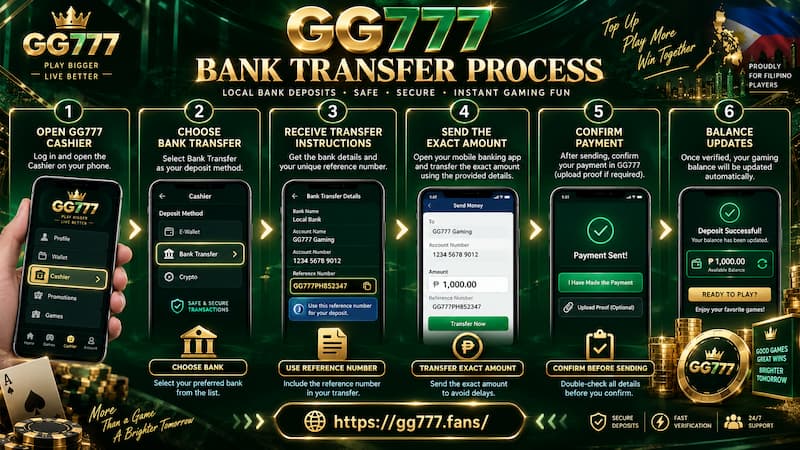
GG777 Bank Transfer Process
When bank transfer is available in the GG777 cashier, the cleanest approach is to treat every deposit as a fresh transaction.
GG777 Bank Transfer Process
A normal flow looks like this:
- Sign in and open the deposit section.
- Select the available bank or online-payment method.
- Enter the amount.
- Read the current payment instructions carefully.
- Open your own banking app and complete the transfer.
- Keep the bank reference or transaction receipt until the balance is confirmed.
Do not assume that details used yesterday remain correct today. This matters especially when payment processing is handled through rotating recipient accounts or different payment partners.
Matching the Transfer Correctly
Small details carry disproportionate weight in bank payments. The amount, recipient information and transaction reference can determine whether an incoming transfer is matched automatically or needs manual checking.
Payment References and Recipient Details
Suppose you intend to deposit PHP 2,000. Your banking app confirms PHP 2,000 was sent successfully, but the GG777 balance has not changed. The first reaction should not be to send another PHP 2,000.
Check:
- Recipient account or bank selected
- Amount transferred
- Date and exact time
- Transaction ID or reference number
- Status shown by your bank
- Deposit history inside your account
Keeping the receipt makes support much easier because the transaction can be traced by something more precise than “I sent money about ten minutes ago.”
Check Before Paying Again
Duplicate payments are one of the easiest mistakes to create yourself.
A banking app can show a completed outgoing transaction before the receiving payment processor finishes reconciling it. If you repeat the transfer immediately, both payments may eventually arrive.
Give the first transaction a chance to be matched and check its status before making a second payment.
Deposits and Withdrawals Follow Different Paths
A deposit and a withdrawal both move money, but operationally they are not mirror images.
With a deposit, the immediate task is identifying an incoming transfer and assigning it to the correct betting account. A withdrawal introduces another set of checks because funds are leaving the gaming account and being sent to a financial account.
That can involve:
- Identity verification
- Bank-account ownership checks
- Withdrawal security credentials
- Internal transaction review
- Payment-provider processing
- Bank crediting time
The Account Name Can Become Important
Using a bank account under the same verified name keeps the transaction trail much cleaner. Third-party payment accounts can create questions about ownership, source of funds and who is actually receiving the withdrawal.
This is not merely administrative paperwork. PAGCOR’s regulatory framework for electronic gaming states that online funding and withdrawals should use AMLC-compliant channels and payment systems, money-transfer services or online-payment providers accredited, approved or registered with BSP.
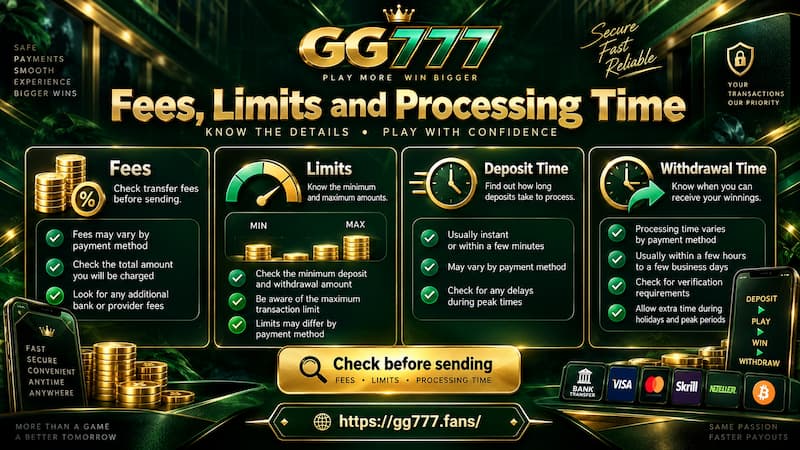
Fees, Limits and Processing Time
“Bank transfer fee” can refer to several different things, so check where a charge actually comes from.
Fees, Limits and Processing Time
A transaction may involve:
- A fee charged by the sending bank
- A transfer fee associated with InstaPay or PESONet
- A payment-provider charge
- A separate operator-side fee, if one applies
BSP requires supervised financial institutions to disclose electronic-payment fees and publishes fee information for participating institutions.
Limits are also layered. InstaPay has a PHP 50,000 per-transaction ceiling under BSP guidance, while your bank can impose additional daily restrictions. A betting cashier may set its own minimum or maximum amount independently of the banking rail.
Bank Completion Is Not Balance Credit
This distinction is easy to miss.
Your bank showing “successful” means the banking instruction succeeded. It does not necessarily mean the receiving system has already matched that transfer to your GG777 balance.
For example, an InstaPay transaction may arrive at the destination quickly, yet reconciliation could still take additional time if a reference is missing or the incoming information needs checking.
Banking Rules Around Betting Payments
Philippine gambling payments sit at the intersection of two regulatory areas. BSP supervises banks and payment systems, while PAGCOR regulates authorized gaming activities.
PAGCOR’s rules allow regulated electronic account funding and withdrawals through channels such as online banking, payment or e-wallet systems and other legitimate money-transfer services, subject to regulatory requirements.
AMLC has also reminded covered persons that online gambling transactions should involve entities duly registered with PAGCOR, with heightened monitoring and due diligence where warranted.
The 2025 In-App Gambling Rule
A change introduced in August 2025 is often misunderstood.
BSP Memorandum M-2025-029 ordered BSP-supervised institutions to remove links from their mobile payment apps and websites that redirected account holders into gambling services.
It did not simply say that every bank transfer connected with regulated gambling was banned.
That distinction matters. Removing direct gambling access from a banking or payment app is different from regulating whether an account-to-account transaction can be processed. Local bank betting payments still depend on the regulatory status of the recipient, payment arrangement and controls applied by the financial institution.
Checks Before Sending a Bank Payment
The best bank-transfer routine is not complicated, but it should be deliberate.
Before pressing Confirm:
- Read the current payment instructions instead of reusing old details.
- Confirm that the recipient account matches the transaction you are making.
- Recheck every digit in the account number.
- Make sure the amount falls inside the displayed limits.
- Save the transaction reference after payment.
- Never give anyone your banking password, PIN or OTP.
- Check the first transfer’s status before attempting a duplicate.
One extra minute spent reviewing the details is far less frustrating than trying to locate a payment sent to the wrong account.
Local Bank Betting Payments in the GG777 Account
Local bank betting payments work best when the banking transaction and the betting-account transaction are treated as two connected but separate steps. First, your bank has to send the money successfully. Then the receiving payment route has to identify and credit it correctly.
For GG777, the practical habit is simple: Use the banking details presented for the current transaction, keep the reference until the balance updates and distinguish a bank-side delay from a payment-matching delay.
Once those pieces are clear, bank payments stop feeling like a black box. You know which details to check, which records to keep and exactly where to start if a transaction does not appear as expected.