


How the Tie Bet Works in Dragon Tiger
Tie Bet in Dragon Tiger wins when the Dragon and Tiger cards have the same rank. The rule is simple, but the payout, probability, and treatment of other bets can vary by game version. Here is how to read the bet correctly before putting PHP on the table.
Tie Bet in Dragon Tiger Rules
Dragon Tiger strips card betting down to a single comparison. One card goes to Dragon, one goes to Tiger, and the higher rank wins. The Tie Bet sits beside those two main choices and covers one specific result: Both cards finish with equal rank.
Equal Card Ranks Create the Tie
A Tie does not require matching suits. These are all winning Tie results:
- Dragon 4♠ and Tiger 4♥
- Dragon 10♦ and Tiger 10♣
- Dragon Q♥ and Tiger Q♠
The suits differ, but the ranks match. That is enough for a normal Tie Bet in Dragon Tiger.
Card ranking is straightforward. Ace is normally the lowest card, followed by 2 through 10, Jack, Queen, and King. There is no blackjack-style addition and no poker hand to build. A King beats a Queen; a 7 beats a 5; two 9s produce a Tie.
Tie and Suited Tie Are Different Bets
This distinction is easy to miss when both betting areas appear close together.
A normal Tie requires matching ranks only. A Suited Tie requires both the rank and suit to match.
Normal Tie
Dragon 8♣ and Tiger 8♦ qualify because both cards are eights.
Suited Tie
Dragon 8♣ and Tiger 8♣ qualify because the rank and suit are identical.
Suited Tie is much harder to hit, which is why some Dragon Tiger versions attach a considerably larger payout to it.
How a Round Reaches a Tie
The cleanest way to understand Tie settlement is to follow an actual round.
Suppose PHP 100 is placed on Tie. Betting closes, the dealer reveals a card for each side, and the result appears immediately.
- Dragon 9 / Tiger 5: Dragon wins.
- Dragon 3 / Tiger Q: Tiger wins.
- Dragon 8 / Tiger 8: Tie wins.
Nothing from the previous round changes those card values. Road maps and result histories can be useful for keeping track of what has happened, but a run of Dragon results does not make a Tie suddenly due.
Dragon and Tiger Bets During a Tie
A Tie result also matters when money is placed on Dragon or Tiger.
Under common eight-deck Dragon Tiger rules, a Dragon or Tiger bet loses only half of its stake when the two cards tie. A PHP 200 wager, for example, would lose PHP 100 rather than the entire PHP 200.
That rule should still be checked inside the specific game being played. Dragon Tiger tables from different providers do not always use identical settlement terms.
Tie Bet Payouts
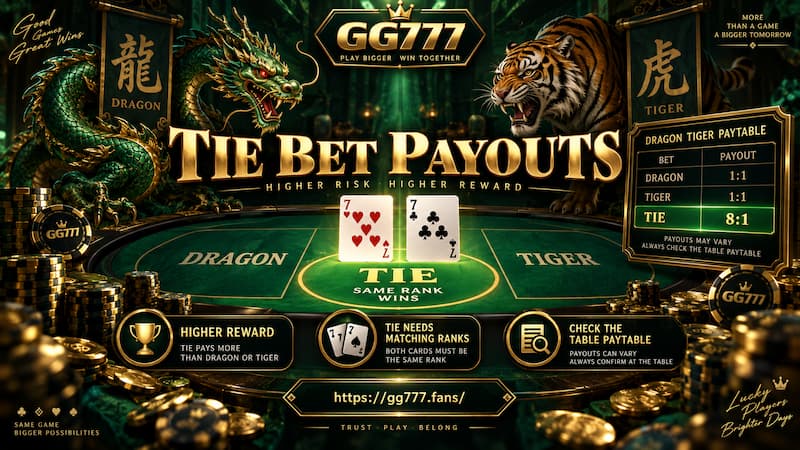
The Tie payout deserves more attention than the name of the bet itself. Two games can use the same basic Dragon Tiger rules while offering very different returns for the exact same Tie result.
Tie Bet Payouts
11:1 Tie Payout
An 11:1 payout is used in well-known Dragon Tiger implementations such as Evolution’s standard game.
If PHP 100 is staked on Tie at 11:1 and the cards match:
- Stake: PHP 100
- Profit: PHP 1,100
- Original stake returned: PHP 100
- Total returned: PHP 1,200
The distinction between profit and total return matters. An 11:1 payout means eleven units of profit for every unit staked; it does not mean that PHP 1,100 is the entire amount coming back.
Some versions also list Suited Tie around 50:1 because matching both rank and suit is considerably less common.
8:1 Tie Payout
Other Dragon Tiger games use an 8:1 Tie payout.
On a PHP 100 winning wager:
- Profit: PHP 800
- Original stake returned: PHP 100
- Total returned: PHP 900
That difference between 8:1 and 11:1 looks small when written on a betting panel, but mathematically it is substantial.
When playing Dragon Tiger through GG777, check the game provider and live casino paytable before choosing a stake. GG777 can provide access to different game versions, so the payout displayed inside the active table is more important than assuming every Tie follows one fixed rate.
Tie Probability and House Edge
The large Tie payout is balanced by a much lower winning frequency than Dragon or Tiger.

Tie Probability and House Edge
In a standard eight-deck shoe, there are 416 cards before dealing begins. Once the first Dragon or Tiger card has appeared, 415 cards remain. Of those, 31 cards share the same rank as the first card.
That gives the Tie a theoretical probability of:
31 ÷ 415 ≈ 7.47%
Put another way, a Tie appears roughly once every 13.4 rounds over a very large sample.
That does not mean the thirteenth or fourteenth round should produce one. Real sessions can easily contain several Ties close together or long stretches without any.
House Edge at 11:1
Using the roughly 7.47% Tie probability with an 11:1 payout produces a theoretical house edge of about 10.36%.
The attractive payout therefore comes with a noticeably higher mathematical cost than the standard Dragon and Tiger bets.
House Edge at 8:1
Reduce the Tie payout to 8:1 while leaving the probability unchanged and the house edge rises sharply to approximately 32.77%.
This is one of the most useful details to check before staking PHP. The cards may work exactly the same way, yet the paytable can completely change the quality of the bet.
A larger number printed beside Tie is not decoration. It directly affects how much value is returned over time.
Tie Bet Compared With Dragon and Tiger
Dragon and Tiger are the main even-money bets. Tie is the higher-payout, lower-frequency alternative.
A standard comparison looks like this:
| Bet | Common Payout | Approximate House Edge |
| Dragon | 1:1 | 3.73% |
| Tiger | 1:1 | 3.73% |
| Tie at 11:1 | 11:1 | 10.36% |
| Tie at 8:1 | 8:1 | 32.77% |
The table explains why the payout alone can be misleading. Winning PHP 1,100 from a PHP 100 Tie bet feels much more dramatic than collecting PHP 100 profit on Dragon, but the chance of reaching that result is far lower.
Tie Works More Like a Side Bet
In practical play, Tie is better understood as a side bet than a substitute for Dragon or Tiger.
Its appeal comes from the occasional high-return result. The trade-off is simple: Fewer winning rounds and a larger house advantage, particularly when the payout is reduced to 8:1.
Knowing that trade-off makes the bet easier to evaluate without relying on streaks or table history.
Reading the Tie Bet Before Staking PHP
A few seconds spent checking the table can prevent most Dragon Tiger Tie mistakes.
Check the Game Provider
Different providers can use different:
- Tie payouts
- Suited Tie payouts
- Minimum stakes
- Maximum stakes
- Side bets
- Tie settlement rules
Do not assume that a rule seen on one Dragon Tiger table automatically carries over to another.
Read the Payout First
If the Tie says 11:1, a PHP 100 winner produces PHP 1,100 profit.
If it says 8:1, the same winning cards produce PHP 800 profit.
The probability of equal ranks may remain unchanged while the return changes dramatically.
Separate Tie From Suited Tie
A normal Tie only needs equal ranks. Suited Tie needs the exact same rank and suit.
Selecting the wrong betting spot changes both the winning condition and the payout, so this is worth checking before the cards are dealt.
Common Tie Bet Errors
Several mistakes come from treating Tie as more complicated than it is—or from overlooking the paytable entirely.
Confusing Tie With Suited Tie
Two Queens of different suits win a normal Tie but not a Suited Tie.
Reading 11:1 as the Total Return
At 11:1, PHP 100 earns PHP 1,100 in profit. With the original stake returned, the total is PHP 1,200.
Assuming Every Tie Pays the Same
Dragon Tiger has no universal Tie payout. An 11:1 table and an 8:1 table can use the same card mechanics while producing very different long-term mathematics.
Chasing a Tie After a Long Gap
Ten, twenty, or even more rounds without a Tie do not create an obligation for the next cards to match. Each new deal depends on the cards available in the shoe, not on a visual streak looking overdue.
The Tie Bet in Dragon Tiger is easy to recognize: Match the two card ranks and the bet wins. The more important skill is reading everything around that simple rule—the exact payout, the distinction from Suited Tie, and the mathematical cost attached to the bet. Once those details are clear, the betting panel becomes much easier to read and compare.