



Why High Volatility Slots Can Feel More Unpredictable
High Volatility Slots can feel more unpredictable because wins may arrive less often and vary more in size. The important part is separating volatility from RTP and RNG, then reading each game’s rules with realistic expectations before deciding how it fits your preferred style of play.
High Volatility Slots and Uneven Results
High Volatility Slots are built around wider swings in results. Instead of producing a steady rhythm of small returns, they can go through long stretches where very little happens, followed by a much stronger payout that changes the feel of the entire session.
That uneven distribution is the main reason these games can feel harsher than low-volatility slots.
A simple example makes the difference clearer. Imagine two slots with similar theoretical RTP figures. One frequently returns PHP 10, PHP 20 or PHP 40 on modest bets. The other produces fewer noticeable wins but occasionally lands a result worth several hundred times the stake.
Both can operate according to fixed mathematical rules, yet the second game feels far less predictable because more of its value is concentrated in rarer events.
Win Frequency and Payout Size
High volatility usually affects two parts of the experience:
- Smaller wins may appear less consistently.
- Larger wins can carry more weight in the overall payout distribution.
- Losing sequences may last longer.
- Bonus features can have a greater influence on the final result.
- Session-to-session swings can become much wider.
This does not mean every high-volatility slot game behaves in exactly the same way. Providers use different reel structures, bonus mechanics, symbol values and feature frequencies. The volatility label gives a useful direction, but it is not a complete mathematical profile.
Variance Creates the Rougher Ride
Variance is the reason two sessions on the same game can look completely different.
One session might end after 80 spins with little more than scattered small wins. Another may hit a free-spin feature after 20 spins and return several times the amount wagered. The second result does not prove the game suddenly became “hot.” It simply shows how widely short-term outcomes can spread.
High volatility describes how results may be distributed. It does not reveal what the next spin will do.
RNG Keeps Every Spin Uncertain
Volatility and randomness are often mixed together, but they describe different things.
A Random Number Generator determines the outcome of each eligible spin according to the game’s programmed probabilities. In properly designed slot systems, previous losses do not create a debt that the next spin has to repay.
That point matters because high-volatility games can produce emotionally convincing patterns. Ten quiet spins followed by another ten quiet spins can easily create the feeling that something must happen soon.
Mathematically, that feeling is not a prediction.
Each Spin Starts With Its Own Outcome
A long losing run does not automatically improve the next spin.
Likewise, landing a large win does not mean the following spin has become less capable of producing another one. The game continues according to its programmed probability model unless a feature specifically changes the state, such as a held multiplier, accumulated meter or persistent bonus mechanic.
That distinction prevents one of the most common mistakes around High Volatility Slots: Treating recent results as evidence of what comes next.
Streaks Can Look More Meaningful Than They Are
Human attention naturally notices clusters.
Three bonuses in a short period feel unusual. Twenty spins without a meaningful return feel even more dramatic. Yet randomness regularly produces streaks that look intentional when viewed in a small sample.
This is especially noticeable in high-volatility titles because the distance between important events can be larger.
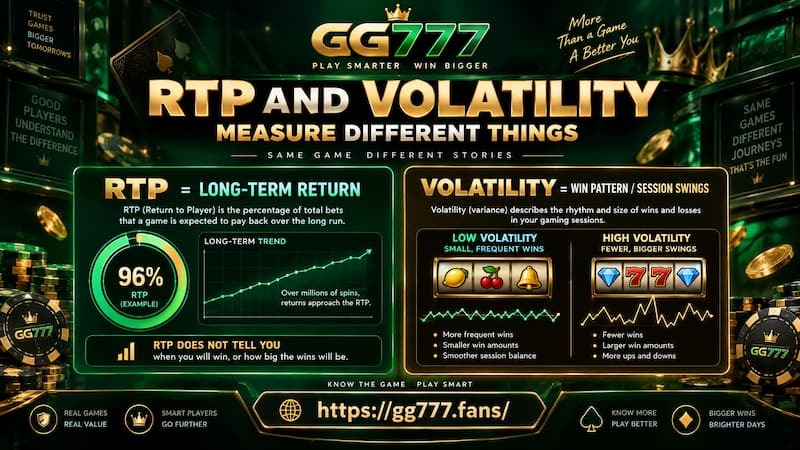
RTP and Volatility Measure Different Things
RTP and volatility answer two separate questions.
RTP refers to theoretical long-term return. Volatility describes how smoothly or unevenly that return may be distributed.
A slot with 96% theoretical RTP does not promise PHP 960 back from PHP 1,000 wagered during one session. The figure is designed around very large numbers of game rounds, far beyond what a normal player is likely to complete in one sitting.
RTP and Volatility Measure Different Things
Similar RTP Does Not Mean Similar Sessions
Consider two theoretical games:
- Game A: 96% RTP with low volatility.
- Game B: 96% RTP with high volatility.
Game A may produce more regular smaller wins, creating a steadier balance movement.
Game B may return less frequently while reserving more value for larger combinations, multipliers or bonus rounds.
The RTP can be similar while the experience is completely different.
Four Numbers Worth Separating
When the information is available, read these metrics independently:
- RTP: Theoretical long-term return.
- Volatility: How widely results can fluctuate.
- Hit frequency: How often a winning result occurs.
- Maximum win: The largest payout permitted by the game’s rules.
None of these figures predicts the next result.
Short Sessions Amplify High Volatility
High Volatility Slots can feel particularly severe when the session is short because small samples exaggerate swings.
Suppose a game is played at PHP 10 per spin for 100 spins. That creates PHP 1,000 in total wagers, but 100 spins remain a tiny sample compared with the millions of rounds used to model long-term performance.
The session may finish before one of the rarer high-value events appears.
Dry Runs and Clustered Wins
This is where expectations often break down.
A player may see several small wins but still end well below the starting balance because those returns were not large enough to offset the total stakes. Another session might look poor for most of the way, then change sharply after one bonus round.
Neither pattern contradicts the advertised volatility.
High volatility simply allows more room for those extremes.
A Bonus Can Carry More Mathematical Weight
Some slots put a meaningful portion of their payout potential inside free spins, multipliers or special features. If those features trigger infrequently, the base game may feel unusually quiet.
That does not mean every bonus will be large. A free-spin round can still return less than the amount spent reaching it.
The important question is where the game concentrates its strongest outcomes.
Features That Increase the Swing
Certain mechanics can make a high-volatility design feel even more dramatic.
Multipliers, Cascades and Bonus Rounds
Common examples include:
- Progressive multipliers.
- Free-spin rounds with enhanced symbols.
- Cascading or tumbling reels.
- Expanding wilds.
- Collect mechanics.
- Bonus buys where permitted by the game and local rules.
- Very high maximum-win multipliers.
Some Megaways slots combine changing reel heights with cascades, multipliers, or bonus rounds, so their volatility still needs to be checked title by title.
Maximum Win Is Not the Same as Typical Win
A 10,000x or 20,000x maximum win can dominate attention, but maximum payout is an extreme endpoint, not a typical result.
Reading only the headline multiplier gives a distorted picture.
Nolimit City slots are a useful example because many of the studio’s better-known titles combine high or extreme volatility with mechanically dense bonus features.
Reading High Volatility Slots on GG777
When browsing High Volatility Slots on GG777, the practical starting point is the game information screen and paytable, not a recent winning screenshot or a short streak of results.
Check the Game Data First
Where the provider publishes the details, look for:
- RTP percentage.
- Volatility rating.
- Hit frequency.
- Maximum win multiplier.
- Minimum and maximum PHP bet.
- Bonus trigger rules.
- Special symbol behavior.
- Feature-specific conditions.
Not every provider publishes every metric. If hit frequency or feature odds are missing, they should not be guessed from a short session.
Stake Size Does Not Change Volatility
Increasing a wager from PHP 5 to PHP 20 changes the money exposed per spin. It does not automatically turn a high-volatility slot into a lower-volatility one.
The same game mathematics generally remain in place unless the title explicitly offers different modes with separate rules or configurations.
That distinction is useful because larger stakes can make normal variance feel more dramatic even when the underlying volatility classification has not changed.
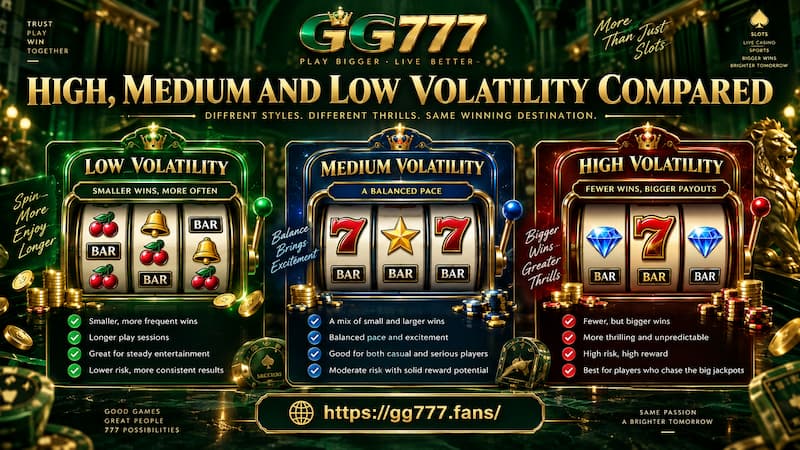
High, Medium and Low Volatility Compared
The easiest way to understand volatility is to compare the expected rhythm rather than search for a “best” category.
High, Medium and Low Volatility Compared
Different Profiles, Different Experiences
Low volatility tends to favor more frequent smaller returns and smoother balance movement.
Medium volatility usually sits between the two extremes.
High volatility accepts longer gaps between meaningful outcomes in exchange for a wider possible payout range.
The difference is not about one category being mathematically superior.
It is about how the same amount of theoretical return can be distributed across thousands of possible outcomes.
High Volatility Is a Preference, Not an Advantage
Someone who enjoys frequent reel activity may find very high volatility frustrating.
Another person may prefer the suspense created by rarer but potentially larger events.
Neither preference changes the probability of the next spin.
Choosing Volatility With Clear Expectations
High Volatility Slots make more sense once they are treated as a distribution profile rather than a hidden pattern.
Before playing, check the RTP, volatility rating, bet range and feature rules. Keep maximum win figures in perspective. Most importantly, do not treat a losing streak as evidence that a large payout is getting closer.
The unpredictability comes from wider short-term variation, while RNG keeps individual results uncertain.
Once those two ideas are separated, high volatility becomes much easier to read: The game may swing harder, bonuses may carry more weight and sessions may look radically different, but none of that turns recent spins into a forecast of the next one.