



How Casino Gaming Developed in the Philippines
History of Filipino Casinos follows a clear shift from government-controlled gaming rooms to large integrated resorts and regulated digital formats. The goal here is simple: Trace the legal, commercial, and technological changes that built the casino industry seen today.
History of Filipino Casinos and the PAGCOR Era
Modern casino history in the Philippines has a practical starting point in the late 1970s. Before then, casino activity existed without the centralized framework that would later define the industry. Concerns over illegal casino operations pushed the government toward tighter control rather than allowing gaming venues to develop under fragmented oversight.
PAGCOR Is Established
Presidential Decree No. 1067-A created the Philippine Amusement and Gaming Corporation, or PAGCOR, in 1977. Its creation marked a fundamental change: Casino gaming was becoming an activity that the government intended not only to supervise but also to operate and use as a source of public revenue. PAGCOR identifies the spread of illegal casino operations as one of the reasons behind its establishment.
Early operations looked very different from today’s sprawling resorts. One of the first notable ventures involved the Philippine Tourist, a floating casino. The idea sounds unusual now, but it shows how experimental the business still was. Philippine casino gaming had not yet settled into the hotel-resort model that would later become familiar.
The early casino era was defined less by luxury and more by one central question: Could gaming be organized, controlled, and turned into a sustainable regulated industry?
That question shaped the next several decades.
Casino Filipino Builds a National Structure
The decisive legal step came in 1983 through Presidential Decree No. 1869, commonly known as the PAGCOR Charter. It consolidated earlier rules and gave PAGCOR authority to regulate, operate, authorize, and license casino gaming. Its mandate also connected gaming revenue with government programs and tourism development.
From Individual Casinos to Casino Filipino
Casino Filipino became the recognizable identity for PAGCOR-operated casinos. Instead of casino gaming being concentrated in a single experimental venue, branches and satellite operations gradually appeared in different parts of Luzon, Visayas, and Mindanao.
That expansion changed the practical experience of casino gaming. A visitor no longer had to associate casinos solely with one Manila location. Gaming floors with table games and machines became part of a wider domestic network.
The structure was unusual compared with many other markets because PAGCOR carried two major roles at once:
- Operating government-owned casino venues
- Regulating and licensing parts of the wider gaming industry
- Generating revenue for government programs
- Supporting tourism-related development
That combination became one of the defining features in the History of Filipino Casinos.
The 2007 PAGCOR Reform
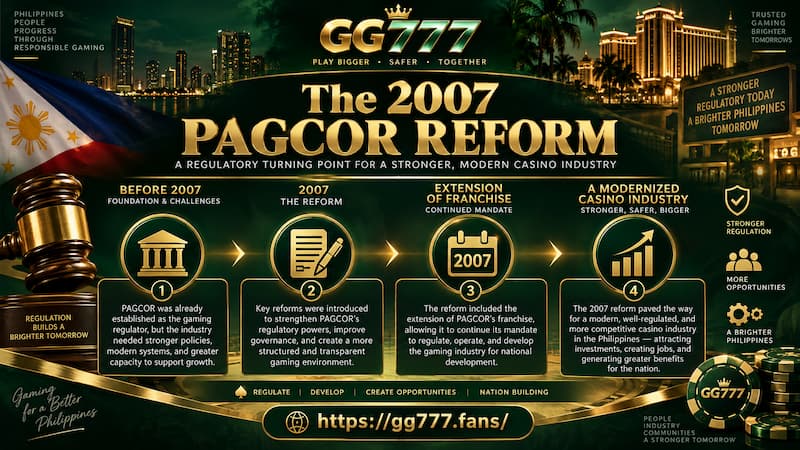
By the 2000s, the industry was ready for another structural change. Republic Act No. 9487, approved in June 2007, extended PAGCOR’s franchise for another 25 years, with the possibility of another 25-year renewal. It also allowed PAGCOR to enter agreements with private firms and required local government consent for operations within their jurisdictions.
The 2007 PAGCOR Reform
Private Investment Gains a Bigger Role
The importance of the reform becomes clearer when looking at what followed. Casino development no longer depended primarily on government-operated Casino Filipino branches. Private companies could participate on a much larger scale under licensing arrangements.
In 2008 and 2009, PAGCOR issued provisional gaming licenses to four proponents for Entertainment City.
This helped create a new model built around three connected pieces:
- Government regulation through PAGCOR
- Private investment in casino properties
- Tourism, accommodation, dining, retail, and entertainment built around gaming
A casino could now be part of a destination rather than the destination itself.
Integrated Resorts Reshape Casino Gaming
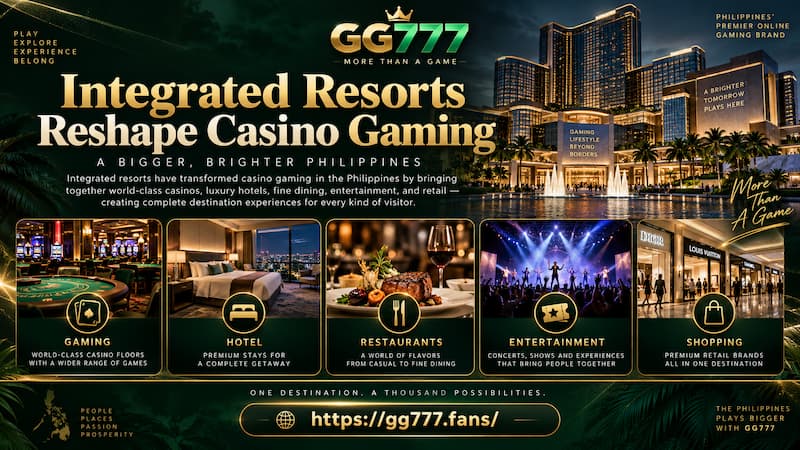
The change became visible in August 2009 when Resorts World Manila began commercial operations. Located across from NAIA Terminal 3, it brought gaming together with hotels, restaurants, shops, entertainment, and other leisure facilities. TIEZA identifies it as the country’s first integrated tourist hub of its kind.
Integrated Resorts Reshape Casino Gaming
For visitors, this was a different experience from walking into a conventional casino branch. A weekend could include a hotel stay, dinner, shopping, a theater performance, and time on the gaming floor without leaving the complex.
Entertainment City Expands the Model
The Manila Bay area pushed the concept much further.
Solaire Resort & Casino commenced operations on March 16, 2013. City of Dreams Manila followed in December 2014, with its formal grand launch in February 2015. Okada Manila began casino operations on December 30, 2016.
Casinos Become Full Tourism Destinations
These properties changed the scale of casino development. Large gaming floors remained important, but they now sat beside hotel towers, restaurants, entertainment venues, retail areas, and event spaces.
That distinction matters historically. The Philippine casino industry had moved through several recognizable stages:
- A tightly controlled government gaming model
- A national Casino Filipino network
- Licensed private casino development
- Large integrated resorts competing as entertainment destinations
Each stage added something rather than completely replacing the one before it.
Electronic Gaming Moves Beyond the Casino Floor
Physical resorts were only one side of the transformation. Electronic gaming created another route.
Dedicated e-Games facilities appeared well before smartphones became the normal way people accessed digital entertainment. Instead of entering a traditional casino floor, customers could use computer terminals to access electronic versions of familiar casino formats.
That early model was still tied to physical locations, but the underlying change was important: The game no longer needed a physical table, dealer, or slot cabinet sitting directly in front of the customer.
Mobile Access Changes the Scale
As internet access and smartphones became part of daily life, electronic casino gaming moved beyond dedicated terminals. Account-based access, mobile interfaces, digital payments, and games delivered remotely changed how casino products could be reached. The same infrastructure also helped mobile sports betting become part of the wider digital gaming market.
By 2024, PAGCOR reported that eCasino games, e-Bingo, and sports betting generated PHP154.51 billion in gross gaming revenue, equal to 41.5% of total industry GGR that year. That growth also shows how casino activity increasingly overlaps with the broader sports betting and gambling industry.
That figure captures how far the digital side had moved from its early café-based roots. It was no longer a minor extension of physical gaming.
Domestic Online Gaming Is Not the Same as Offshore Gaming
One historical distinction is essential. Domestic electronic gaming and Philippine Offshore Gaming Operators were not the same regulatory category.
Following Executive Order No. 74, PAGCOR cancelled all Internet Gaming Licensee and Authorized Provider licenses connected with offshore gaming effective December 15, 2024. Domestic regulated electronic gaming developed under a separate framework.
Mixing the two together creates a distorted version of recent casino history.
GG777 and the Current Digital Casino Format
The latest stage in the History of Filipino Casinos is no longer defined by a single type of venue. Physical Casino Filipino branches, privately operated integrated resorts, and digital casino services now represent different generations of the same long transition.
Brands such as GG777 fit into this digital-era context. Instead of requiring a trip to a gaming floor, online casino access is built around personal accounts, mobile devices, digitally delivered games, and transactions handled in PHP.
The historical point is more important than the technology itself. Casino access gradually moved from a particular building, to an integrated destination, and eventually to something that can exist on a phone screen.
GG777 therefore belongs near the end of the timeline, not at the beginning. Treating a modern online brand as though it played a role in the early PAGCOR or Casino Filipino years would blur very different periods of development.
Five Decades of Casino Development
The History of Filipino Casinos becomes easier to understand when reduced to its major turning points:
- 1977: PAGCOR emerges as the central government body for casino gaming.
- 1983: The PAGCOR Charter formalizes a broader regulatory and operational structure.
- 2007: Legal reforms create more room for private participation.
- 2009 onward: Integrated resorts expand casino gaming into large-scale tourism and entertainment.
- 2010s and 2020s: Electronic and mobile gaming become increasingly important alongside physical casinos.
The result is not a simple story of old casinos disappearing and new ones replacing them. Government-operated casinos remained while private resorts grew. Physical gaming continued while digital access accelerated.
That layered development is what makes the Philippine casino market distinctive. In less than half a century, casino gaming moved from experimental state-controlled operations to a mixed industry spanning traditional casino floors, billion-peso resort complexes, and mobile-first digital gaming.